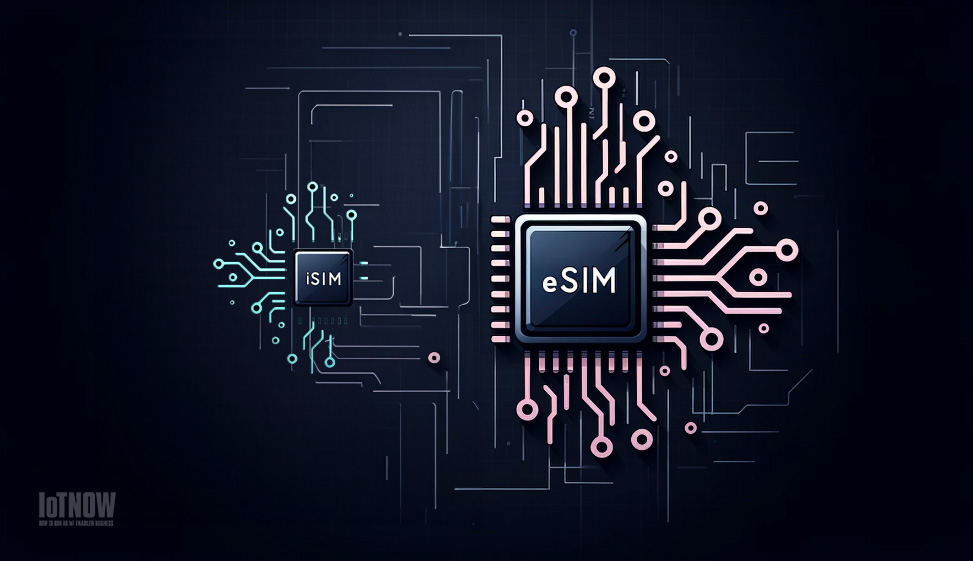
Now the initial phase of innovation is complete and real deployments are happening at scale, it is clear to see that eSIM is bringing greater benefits to adopter organisations. In IoT, this means radical simplification of the traditional plastic SIM card model with enormous production, manufacturing, configuration and deployment savings to be made. The advantages to the cellular IoT market this delivers in terms of flexibility and choice are allowing creation of single devices for global markets that can be shipped with embedded connectivity.
Much of this has been streamlined by the introduction of the SGP.31/32 specifications from GSMA which play a critical role in preparing eSIM for mass adoption, especially on low power wide area network (LPWAN) devices that utilise newer cellular variants such as NB-IoT, Cat1 and Cat1 bis and, soon, 5G Reduced Capability (Red Cap). The specification reduces the complexity involved in switching between network profiles thereby making it easier for IoT organisations to manage devices, ensure optimal network coverage and access more attractive commercial offerings.
Although widely used in consumer cellular markets, having been driven by Apple and others, eSIM has faced a tougher path in IoT devices. Constraints on battery life, computing power and requirements for end user intervention have limited eSIM’s appeal but these challenges are being addressed effectively to the extent that analysts expect eSIM to gain traction in IoT rapidly. Research firm Omdia believes that advances in eSIM technology will drive adoption in IoT from just over one billion in 2023 to more than 3.6 billion in 2030. “eSIM technology has long been seen as an important form factor for IoT devices, but now we are seeing the technology improve in ways that help enterprises provision over-the-air in resource-constrained IoT devices,” explains John Canali, the IoT principal analyst at the firm. “This will create greater competition between communication service providers (CSPs), as IoT enterprises are less subjected to vendor lock-in by the CSPs and are better positioned to renegotiate connectivity tariffs.”
Omdia’s eSIM forecast is supported by primary data that it collected during a survey of over 700 global IoT enterprises in which nearly 90% of respondents planned to adopt eSIM or integrated SIM (iSIM) technology over the next two years. Aside from the increased security that these technologies offer, IoT enterprises also prioritised the benefits of eSIMs to create more complete and reliable networks, to help manage costs and to support improved ability to comply with local regulations.
“The new GSMA SGP.32 eSIM specification was much needed and has been specifically designed for IoT,” adds Andrew Brown, the practice lead for IoT at Omdia. “It offers significant advantages in terms of cost, flexibility and longevity for hardware OEMs, finally beginning to bridge the gap between traditional consumer device provisioning and more traditional IoT devices. This will help to accelerate adoption in key industries, not only those that have long desired eSIM standardisation, such as automotive, but in a multitude of others also.”
A similar, although more cautious, report has also been published by Kaleido Intelligence, which predicts that more than 1.4 billion eSIMs (including eUICC and iUICC form factors) will be shipped in 2028. That figure suggests adoption will grow at a CAGR of 21% between 2023 and 2028, with growth dominated by consumer uptake. The firm’s report has highlighted the importance of a having a fully end-to-end digital onboarding process for consumer devices for achieving scale. The firm says many MNOs continue to rely on QR code mechanisms which do not offer an optimal end-user experience.
A critical factor behind the drive towards end-to-end digital onboarding will come from increased entitlement service uptake and digital BSS modernisation which are key to supporting and digitally enabling eSIM connectivity for disparate consumer devices. Market disruption, in the form of travel eSIMs in addition to widespread enablement of the ability to transfer an eSIM from one device to another, will effectively result in competitive differentiation, forcing the market to take new shape. As a result, mobile operators will be forced to embrace eSIM and Kaleido anticipates that smartphone eSIM activations will grow on average by 77% between 2023 and 2028.
The picture is different in the non-consumer market where the SCP.31/32 specifications are only now starting to see commercialisation. This will result in a reduced technical and investment burden for supporting IoT connectivity and, although many mobile operators may not have retail IoT connectivity strategies in place, the new specifications offer considerable opportunities for wholesale offerings. Kaleido expects well over half of active IoT eSIMs to use the new specification by 2028, and demand for connectivity profiles will be greater than ever before.
Historically, the use of eSIM for NB-IoT and LTE-M connectivity has been challenging, Kaleido explains. The M2M specification demanded support for SMS or TCP/IP, while eSIM profiles were considered large enough to be taxing on low-bandwidth, battery-powered devices. The IoT specification addresses LPWAN devices directly, by opening up constrained application protocol (CoAP) support for transport, while, critically, the Trusted Connectivity Alliance (TCA) has introduced a lightweight eSIM profile that reduces the power burden for over-the-air eSIM LPWAN campaigns.
“The eSIM market has seen several developments recently that smooth the path to adoption, and address many lingering ecosystem challenges,” says Steffen Sorrell, the chief of research at Kaleido. “The effect of this will mean eSIM or iSIM form factors will gradually become a de facto requirement by 2028 for most cellular devices.”
Comment on this article via X: @IoTNow_