SoftBank Corp. announced that it developed a feature that isolates the network to the edge Artificial Intelligence (AI) server on “AITRAS”, a converged solution of AI-RAN, enabling secure access. This is achieved through edge routing to the edge AI server on AITRAS, utilising Local Breakout technology, a feature of 5G Standalone (SA). Furthermore, using this technology, SoftBank developed a Large Language Model (LLM) application capable of handling highly confidential data.
In the AI era, the utilisation of data is becoming increasingly important. However, handling highly confidential data, such as proprietary corporate information and personal data, requires processing in a highly secure environment. One such method is performing AI processing in a private environment, distinct from public models. In SoftBank’s development of AITRAS, a private environment is also configured to function as an edge AI server. To ensure a more secure operation of edge AI servers, access must be established through a network path distinct from that used for standard Internet connections. To address this, SoftBank has implemented secure access to the edge AI servers on AITRAS through edge routing, using the User Equipment Route Selection Policy (URSP) and Local Area Data Network (LADN) technologies of 5G SA’s Local Breakout function.
URSP is a policy that specifies the characteristics of network paths in 5G. By configuring URSP, user devices can be assigned multiple Protocol Data Unit (PDU) sessions with different characteristics from the core network. Additionally, it allows applications to be configured to select the PDU session they wish to use. By directing a PDU session to a local network instead of the standard internet connection, devices can establish a dedicated and secure communication path, enabling local breakout.
LADN is a function that enables or disables PDU sessions based on the device’s location, as determined by URSP. This allows PDU session usage to be restricted depending on the specific area, ensuring controlled and efficient network access.
SoftBank developed two LLM applications that run on the edge AI server of AITRAS, utilising local breakout technology.
(1) LLM switching application utilising URSP
To handle highly confidential corporate information with LLMs, companies need to build their own proprietary LLMs. By deploying these proprietary LLMs within the edge AI servers on AITRAS, organisations can securely manage sensitive data. At the same time, various LLMs are emerging rapidly, with continuous advancements in performance. By effectively switching between proprietary LLMs and external LLMs, businesses can enhance operational efficiency and improve usability.
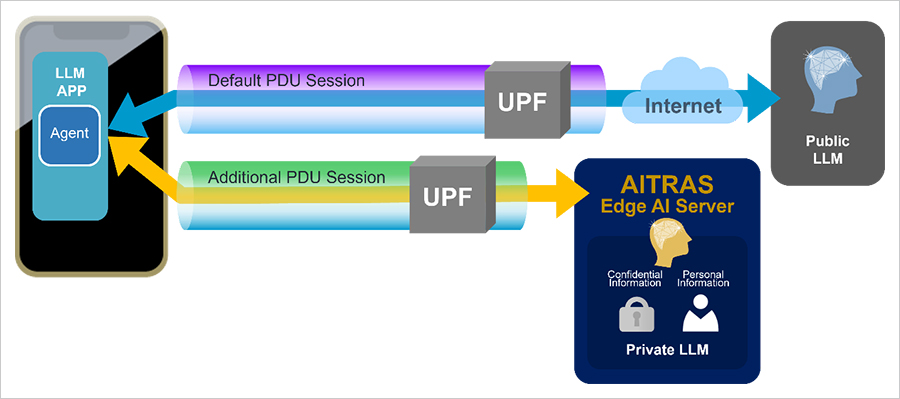
SoftBank developed an application that enables access to both public and private LLMs by utilising URSP to simultaneously configure PDU sessions for both the Internet and the edge AI servers on AITRAS. Furthermore, SoftBank implemented an AI agent that operates on the device using a lightweight LLM to assess the confidentiality of user input. This allows for an automatic switching mechanism between public and private LLMs without requiring users to manually select which LLM to use. With this approach, employees using company-issued work devices can use LLMs while ensuring compliance with corporate security policies, regardless of individual awareness of confidentiality requirements.
(2) Multimodal RAG application utilising LADN
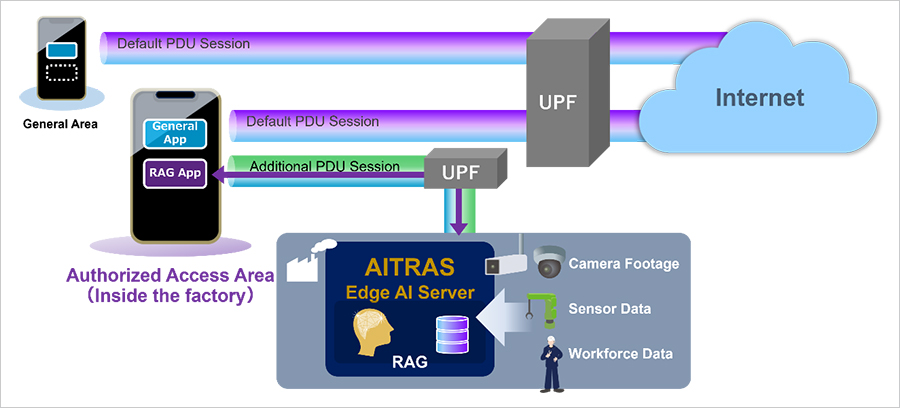
As AI adoption expands across industries, its potential applications in manufacturing are also evolving. For example, AI could autonomously understand the overall factory environment, issue instructions to production equipment, and verify information without human intervention. To support such use cases in the manufacturing sector, SoftBank developed an LLM application compatible with LADN. This application enables PDU sessions only within designated areas, such as factory premises, allowing access to the edge AI server on AITRAS exclusively within the factory. By restricting LLM access to on-site use, this solution enhances security and ensures a highly controlled AI deployment environment.
Additionally, SoftBank built a multimodal Retrieval-Augmented Generation (RAG) system on the edge AI server of AITRAS, which is capable of processing various types of data, including sensor readings from factory equipment and surveillance camera footage. By using multimodal information such as video, audio and sensor data, this system enables more precise responses to user inquiries, enhancing the accuracy and reliability of AI-driven decision-making in industrial environments.
Moving forward, SoftBank will continue to develop new features and expand use cases by integrating AI-RAN with mobile network technologies, contributing to solving social challenges through AITRAS. Additionally, SoftBank published a white paper that includes details on this technology. For more information, please refer to the following link (https://www.softbank.jp/en/corp/technology/research/news/065/).
Hideyuki Tsukuda, the executive vice president and CTO at SoftBank Corp., said: “This demonstration of concrete solutions through the integration of AI and mobile network technology has highlighted the critical role of mobile networks in an AI-integrated society. To serve as the foundation for an AI-integrated society, it is crucial to focus not only on the implementation of ‘AITRAS’ as a Radio Access Network (RAN) but also on end-to-end design. Moving forward, we will drive innovation centered around ‘AITRAS’ while considering end-to-end solutions, aiming to develop high-value social infrastructure.”
Comment on this article via X: @IoTNow_ and visit our homepage IoT Now