
IoT relies on manufacturing efficiency to get massive volumes of devices out into the market at an acceptable price and rapidly enough to take advantage of opportunities. Manufacturers have been challenged to ensure all the capabilities an IoT device needs can be accommodated within often small form factors without causing interference or excessive power consumption. These design issues then become production issues as the factory environment needs to be able to take account of variations while working within size, weight and price constraints.
Automation and robotisation are stripping costs from manufacturing environments and IoT organisations are practicing what they’re preaching by using sensors, robots and other devices to drive efficiency. The rewards are enormous because the sheer scale of IoT means that every cent saved in manufacture is multiplied many times over because of the large volume of devices that original equipment manufacturers (OEMs) are constructing. This is exacerbated in markets such as the automotive sector in which complex systems and sub-systems involve multiple devices and components which need to be pre-integrated where possible in the factory.
The advantage of adding as many functional blocks as possible at the point of manufacture is that it simplifies and accelerates deployment and installation of IoT devices enabling use cases to become reality faster, less expensively and with minimised manual or physical interactions. From security to connectivity more can be designed-in to devices and built-in at the factory, enabling simplified logistics, fewer device variants and smoother routes to achieving global compliance.
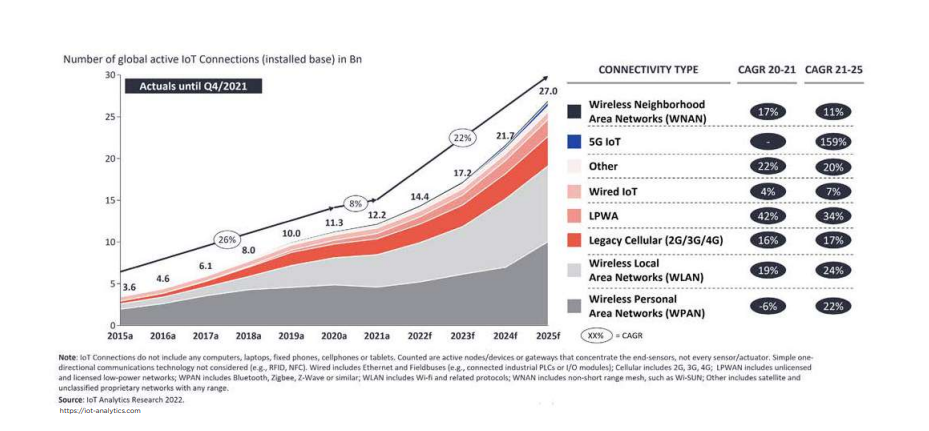
Source: IoT Analytics, May 2022
Although easy to understand from a conceptual point of view there are substantial production complexities, security, connectivity, reliability and compliance issues for OEMs to overcome and they must do so as their production lines scale up to meet demand for the next generation of IoT devices.
Research firm IoT Analytics has reported that in 2022, the market for Internet of Things is expected to grow 18% to 14.4 billion active connections. The firm estimates that by 2025, as supply constraints ease and growth further accelerates, there will be approximately 27 billion connected IoT devices. Someone is going to have to manufacture these and OEMs are gearing up to enable as many functions as possible to be integrated into the devices they build. The advantage of this approach is that fewer steps are needed in the process of bringing a device to the point of use and significant cost and time can be saved.
To achieve this across all industries and global markets, further standardisation will be needed but industrial regulation, communications technology legislation and IT standards provide a broad foundational framework for manufacturers to work to. This includes contract manufacturers making IoT devices on behalf of others alongside brands that also build their own hardware. To bring the price down and speed up, manufacturers will have to adopt IoT technologies in their factories to power their digital transformations and enable improved productivity, increased efficiency, lower costs and faster reaction times.
Get the factory right first
None of this is easy and although consulting firm McKinsey projects IoT could enable US$5.5tn to US$12.6tn in value globally by 2030, it warns that organisational challenges, technology cost, cybersecurity threats, lack of interoperability and convoluted installation requirements have resulted in many initiatives becoming stuck at the pilot stage. The starkest example of this, the firm says, is in factories where 70% of manufacturers have been unable to scale beyond pilots.
The smart factory is an essential enabler of smart manufacturing and the capabilities that massive IoT demands and therefore needs to be prioritised so it can deliver the performance IoT brands, service providers and product companies need. This isn’t new and manufacturers have already made substantial investments in their own digital transformations.
ABI Research has predicted that spending on smart manufacturing will grow from US$345 billion in 2021 to more than US$950 billion in 2030. “As manufacturers advance their digital transformation initiatives, they drive up spending on smart manufacturing with investments in factories that adopt Industry 4.0 solutions like autonomous mobile robots (AMRs), asset tracking, simulation and digital twins,” the firm’s research director, Ryan Martin, has said.
Polaris Market Research sees significant expenditure specifically on IoT solutions in manufacturing. It reports in Figure 2 that IoT in the global manufacturing market was valued at US$50.07bn in 2021 and is expected to grow at a CAGR of 12.3% over the period 2021-2030 when the revenue is forecast to hit US$129.42bn. Implementing technology in a wide range of applications across many industries has created a huge opportunity for companies in the market, the firm says.
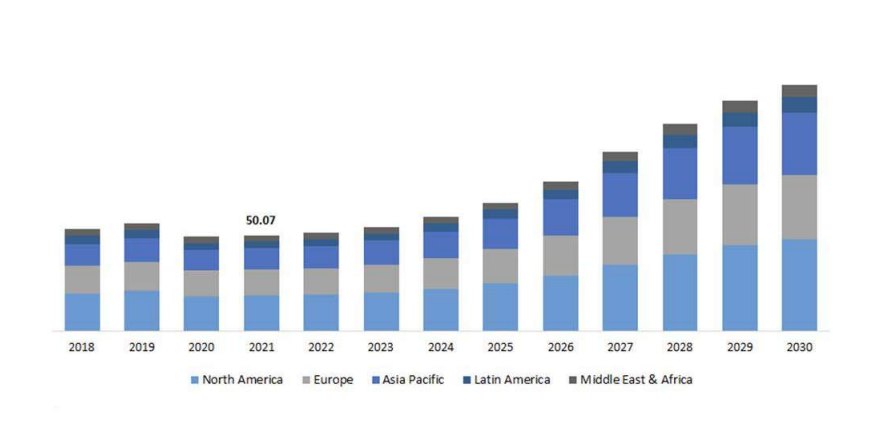
Source: Polaris Market Research
The manufacturing sector’s increased demand for automated machines and equipment will lead to increased usage of IoT technologies, according to Polaris Market Research. IoT in the manufacturing industry will need to respond to growing demand for customisation, heightened expectations for simpler products and the requirement for efficient and reliable data. Innovations including sensing devices and virtual and enlarged reality will add further pressure while concerns about data protection and privacy and a lack of precise standards for interoperability and connectivity limit what OEMs can do to stimulate IoT and hit large volumes.
Why manufacturing is so important
If you can’t build hundreds of thousands – or potentially more – of devices that can be shipped anywhere in the world at a price-point that is viable while offering the connectivity, security, compute power and compliance with regulations that sales demand, your IoT concept will not become reality. OEMs and manufacturers therefore play a fundamental and critical role in making IoT happen at scale.
When McKinsey assessed the potential for economic impact in 2030 across a range of business settings, the factory setting had the greatest economic potential. The firm estimates that the economic impact of IoT in factories could range from US$1.4 trillion to US$3.3 trillion by 2030 and factories could represent 26% of IoT’s overall economic potential in 2030. Within this, the firm puts manufacturing itself at a value of US$1 trillion to US$2.3 trillion.
Based on its research, see Figure 3, the greatest potential for value creation is in optimising manufacturing operations – making the day-to-day management of assets and people more efficient. Overall, operations management applications in manufacturing could account for about 32-39% of the total potential economic value created in factories, that’s about US$0.5 trillion to US$1.3 trillion by 2030.
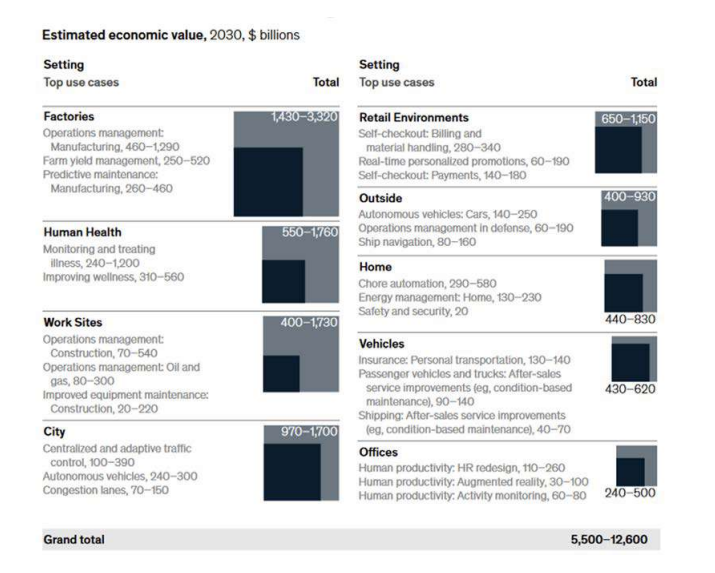
Source: McKinsey
There are now many examples of factories that have deployed IoT at scale and are capturing significant value from successful deployments. McKinsey cites Schneider Electric’s 50-year-old Le Vaudreuil site in France which was able to save 10% on energy costs using IoT sensors and to reduce diagnosis and repair time by 20% by supporting factory workers with augmented reality. Examples such as this illustrate the gains that can be made but manufacturers now need to look outwards as well to ensure they are well-positioned to manufacture efficiently and scale up their IoT-enabled systems so they can support the future of IoT itself.
Five challenges for smart manufacturing to overcome
There are five key challenges facing digital transformation in manufacturing as OEMs grapple with IoT demands but these are not always the same challenges that IoT devices themselves want to see manufacturers address. Figure 4 sets out how respondents to an IoT Analytics survey view the smart factory and the goals it should deliver to their business. Many of these advantages feed through to the cost, time-to-market or compliance of IoT devices but some are manufacturing-specific.
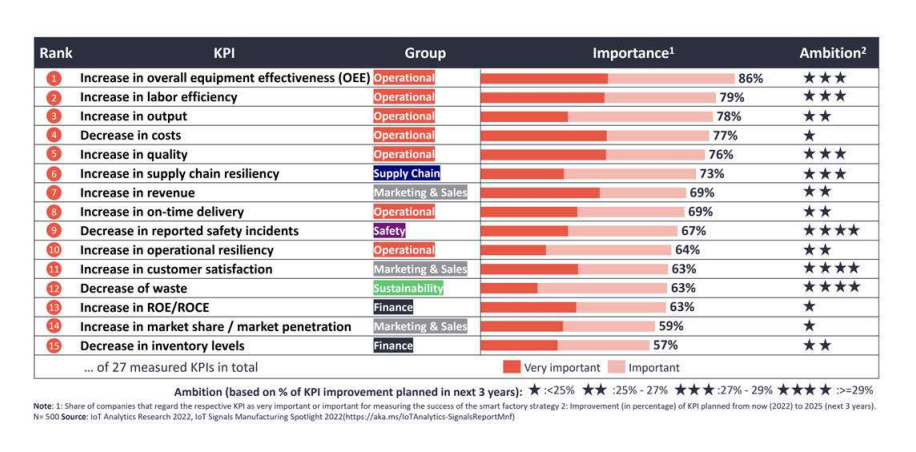
Source: IoT Analytics Research, 2022
Examples of performance gains
Typical IoT device manufacturing challenges, in contrast to purely factory-based challenges, include:
– Production complexity
– Security
– Connectivity
– Quality control
– Configuration/installation
The advances made in embedded SIM (eSIM) and integrated SIM (iSIM) enable IoT products that are to be shipped to multiple regions to be pre-installed with SIMs. This enables a single variant and one stock-keeping unit (SKU) number for the IoT device, contributing significantly to reducing production and logistics complexity. Supply and demand spikes that affected regional or nation-specific products can be smoothed out across a global product with a single SKU. An additional benefit is that the eSIM requires no physical handling which can introduce errors.
Developments in security are also enabling OEMs to embed secure approaches and follow through on companies’ security by design strategies. Trusted key infrastructure which encompasses the generation and storage of keys can work across multiple electronics manufacturing services (EMS) partners without requiring specific security standards, special certifications or particular trust roles. The provisioning of keys, secure communications and secure maintenance enable complete lifecycle management and the addition of tamper-resistant storage in a secure element within the device adds further security. The ability to provision the key securely only when the device is in the field is a critical element of secure provisioning and essential for critical infrastructure such as smart meters because it prevents the cloning of devices.
Networking is also providing more options to IoT service providers with 5G arriving, private networks gaining further adoption and greater flexibility being delivered via SIM innovations. For 5G IoT devices, vendors offer SIMs that provide global connectivity out of the box with true always-on connectivity achieved by allowing devices to switch to a fallback provider if there is a service disruption.
This flexibility is supported by vendor-provided activation services which simplify switching providers and the process of moving between private and public networks. It also means there will be fewer service trips because plastic SIMs don’t need to be swapped out when the network provider is changed. Connectivity is also making smaller demands on space within devices with 5G available on an M.2 card form factor while low power requirements can be addressed by low power wide area network (LPWAN) technologies.
OEMs also need to address quality, testing and validation challenges. The presence of an eSIM means after the device has been tested, the SIM can be switched from a test network to the live network. Troubleshooting and debugging can also be addressed securely through test environments and hardware with data fed back to developers so efficiencies can be integrated to future versions. These processes are essential to achieving compliance so devices can be sold in regions but also provide vital data to enable predictive maintenance and other use cases.
Improvements to efficiency don’t begin and end in the factory. OEMs can contribute significantly to simplified device configuration and better preparation for easy installation. Configuration and settings that are easy to deploy and change during manufacturing can be accommodated and this is especially important for high volume deployments such as smart meters or connected alarm panels in which the business case benefits from fast device installation that requires limited training.
Future manufacturing
The smart manufacturing environments of the future present a more active and dynamic environment that the factories of the past. Products will no longer be presented to OEMs and manufacturers as static, finalised propositions and the manufacturer will be expected to adapt and refine the product throughout its production lifespan. Incremental gains will be achieved in this way across security, installation, connectivity, compliance and operational performance.
Being able to take live data from a deployed device and identify how the next generation of devices can be improved and adding that swiftly into the manufacturing chain is the ultimate goal and this introduces the possibility of continuous development. To accommodate this, factories will have to be smarter still than they are today and OEMs will need to apply IoT techniques to achieve this smartness across the multiple dimensions of manufacturing.
The goal of continuously variable manufacturing allows for increased personalisation but also simplified standardisation for bulk products. It all depends on the ultimate business case and the target cost of the product in question. Smart manufacturing will need to make room for both approaches in the factories of the future.
Comment on this article below or via Twitter: @IoTNow_OR @jcIoTnow