The Electric Vehicle (EV) market now stands at a crossroads. It will either continue its steady growth to become the main source of sustainable transport in developed economies. Or it will become part of a spluttering and complicated transport mix, that still sees petrol and diesel do much of the heavy lifting when moving both people and goods from one point to the other.
Antony Savvas attended the recently held London EV Show to find out what was needed from technology providers to help overcome the obstacles the electrical vehicle ecosystem is now facing.
According to the International Energy Agency, around 10 million electric passenger cars were on the world’s roads in 2020, representing only 1% of all cars. But, demonstrating a rapid upward trend, the number of EVs actually increased by 43% when compared to 2019.
Threats
Since then, of course, we’ve had a pandemic, a big increase in energy prices, and a global cost of living crisis made worse by the invasion of Ukraine by Russia. Not surprisingly, the scarcity of cheap power on the global market has meant that some countries have chosen to hold onto the fossil fuels already under their control for a bit longer.
Quentin Wilson, the motoring journalist and TV presenter, and well-known EV advocate, told London EV Show conference delegates: “Last year at this show we could report good progress. Now, there is a cloud. We are in a dangerous situation, as the fuel crisis has led to evangelism in government around EVs to fade
“In the UK, for instance, subsidies for EVs are disappearing, and the target for ending the sale of petrol and diesel cars by 2030 is being threatened by campaigners who are against renewable energy.”
Where’s our truck
Marius Skuodis, minister of transport and communications in Lithuania, outlined his country’s evangelism for EVs, but pointed out some of the problems.
“23% of CO2 emissions come from the transport industry, but where is our Tesla Semi truck,” asked Skuodis. “We were the first to order one five years ago, but are still waiting.”
The electric Semi, unveiled in 2017, reportedly has three times the power of any diesel truck currently on the road, and has a range of up to 500 miles when fully loaded. Production was supposed to have started in 2019, but was delayed to help Tesla meet its back orders for Model 3 sedans.
Incidentally, the first Semi truck was delivered shortly after Skuodis had vented his frustration, but not to Lithuania, to PepsiCo in the US
In Lithuania, said Skuodis, there will be ten times more EV charging points by 2030. But he explained the goal was not to replace every petrol or diesel car with an EV.
“We need less cars overall. People should be able to more easily rent them, when they require them, and through an app.”
Charging blues
On the costs of running EVs, Quentin Wilson said more had to be done to the get the tax regime right, to make it fairer for all car drivers and help drive EV adoption. “In the UK, there are two tax regimes. When you charge on the go, it costs you 20% in VAT, but when you charge at home it’s only 5% VAT on the energy you use,” said Wilson.
But many drivers can’t charge at home, he pointed out, as they live in flats or houses with no drives, particularly in cities. This works against wider take-up of EVs.
To solve all these issues, collaboration between the car makers, the energy industry, governments and infrastructure and communications providers was demanded by various speakers at the event.
Charging infrastructure will create high loads on feeder lines of electricity distribution networks, and this needs to be managed carefully to keep the national grid stable. One “sensible” solution enabled by IoT connectivity, said Jens Erler, IoT client principal at Ericsson, is embedded demand management.
“Charging point operators need to know the available net capacity from energy suppliers at any given point in time, and, in return, should provide at least 24-hour charging predictions to those energy suppliers. This allows automated data-driven operations of both infrastructures,” said Erler.
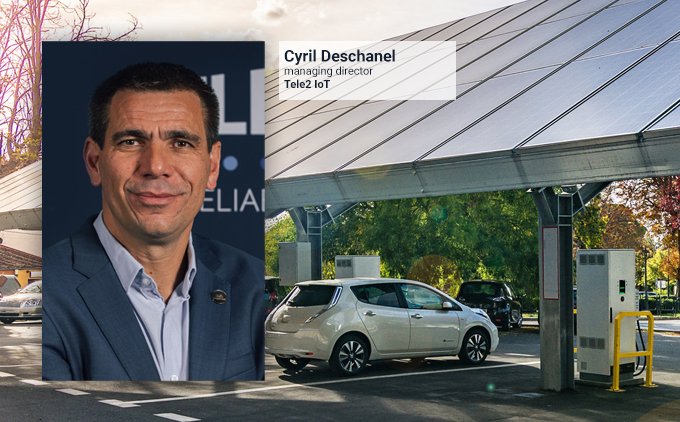
“There has to be standardisation across charging infrastructure and payment systems, and governments will have to work hard to make sure drivers in cities and those using the main roads are well served when it comes to charging,” said Cyril Deschanel, managing director at Tele2 IoT, which was exhibiting at the London EV Show.
Opportunities
On the commercial opportunities for communications service providers (CSPs) in the EV market, Deschanel said: “For Tele2 IoT, under 5% of our business is currently generated from the EV market, but we see this rising to between 15% and 20% in the next five years, which is why we are here.
“In Norway, by 2025, they want only EV cars to be available to buy new, and it’s about 2035 across Europe, so the wider opportunity to deploy smart technology is approaching quickly.”
Connectivity deployed at charging points ensures they are properly managed and maintained.
The opportunity to provide better connectivity is certainly there. Mobile connectivity at public EV charging points is vital because most charge points don’t allow users to just park up and plug in. They often require them to have an app downloaded or to visit a web page to pay for their charging session – meaning that without a signal, they can’t charge their car.
A poor mobile signal may also leave users unable to access support if something goes wrong during their charging session, or if they feel unsafe in locations which are often in dimlylit corners of car parks.
A FarrPoint survey of 4G signal coverage at 100 public EV charging locations across Scotland and the North of England, found that 20% of locations had only a 50% chance of getting mobile coverage.
Only 67% of the locations had access to mobile coverage from all four mobile operators, and 5% had no mobile coverage at all.
“4G at the moment is often good enough for many existing EV charging points, but as new services are rolled out and more EV cars come onto the road, 5G will offer the necessary homogenous connectivity and low latency. We can help the EV industry to improve coverage with the right specifications, said Deschanel.
Some charging points in remote areas may even need satellite connectivity to provide back-up to cellular coverage, he added.
Interoperability
Like others at the conference, Deschanel confirmed there had to be more collaboration. “There has to be more sharing of data between the car makers, the charging point providers, the payment system providers and the IoT SIM providers. If solutions are not universal, they have to be at least interoperable.”
At the moment, most companies using IoT can’t change over seamlessly from one provider to another, with many IoT service providers not supporting eSIM solutions that make it easier to switch.
Deschanel called for the likes of the GSMA, ETSI and other standards bodies to push for eSIM standardisation going forward, and for IoT service providers to make it easier for end customers to swap provider, mirroring the consumer mobile market.
This was only the second year of the annual London EV Show, and it will be interesting to see what the market looks like next year, and if the often mentioned collaboration has happened to get round the multiple problems.

The author is Antony Savvas, a global freelance business technology journalist.