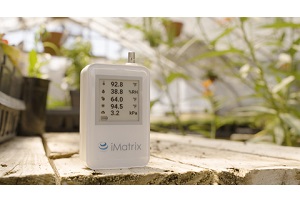
iMatrix Systems, a provider of Internet of Things (IoT) solutions based in the United States, has launched a range of temperature and humidity sensors. These sensors are designed for applications in food and produce storage, transport monitoring, pharmaceuticals, and agriculture.
The NEO Series sensors can measure temperatures within a range of -40°C to 125°C and relative humidity from 0 to 100%. They are particularly well-suited for refrigeration and HVAC systems, where precise control of temperature and humidity is crucial for maintaining product quality and minimising energy costs.
“This series of products can quickly and accurately measure changes in temperature and humidity, making them ideal for use in dynamic refrigeration environments, like cold storage and refrigerated transportation,” says Greg Phillips, CEO of iMatrix Systems. “This helps ensure that items are stored in optimal conditions, reducing spoilage and improving product quality.”
The NEO Series sensors employ Nordic Semiconductor’s nRF52832 SoC, its 64 MHz, 32-bit Arm Cortex M4 processor with floating point unit (FPU) providing ample computational resource to oversee the sensors and capture the temperature and humidity data. Using the Bluetooth LE connectivity of the SoC’s 2.4 GHz multiprotocol radio, this data is relayed to a gateway and in turn to the iMatrix Cloud platform where users can review sensor data in near real time, enabling them to take remedial action in the event temperature or humidity levels fall outside of acceptable tolerances. From the cloud platform users can also access data analysis and visualisation tools, as well as perform device registration, firmware updates and remote configuration.
The NEO Series temperature and humidity sensors can last for up to three years between battery replacements, thanks, in part, to the ultra low power characteristics of the Nordic SoC, including the 2.4 GHz radio’s 5.5 mA peak RX/TX currents and fully-automatic power management system.
“Overall, the nRF52832’s combination of energy efficiency, processing power, memory capacity, wireless connectivity and ease of use made it an attractive option,” says Phillips. “This SoC is also supported by a comprehensive SDK [software development kit] that includes drivers, libraries, and sample code to help product designers get started with software development. The SDK includes tools for debugging, profiling, and optimising code, making it easier to develop high-quality software for the chip.”
Comment on this article below or via Twitter: @IoTNow_OR @jcIoTnow